
Paper Background Texture
Claw Icon

TheClawis theLaw

Claw Icon

Character Dossiers

The Law & The Damned

The cast of The Claw Is The Law is built out of family, criminal etiquette, authored mutations, and systems weird enough to feel lived in instead of random. This page collects the recurring core cast and the key figures who define Issue #1: The Alibi Auction.

Format

Square dossier portraits generated for the site from the canon comic refs.

Scope

Recurring cast first, then the local rogues and operators shaping Issue #1.

World Rule

Person-first sea-morph design, stylish weirdness, and no generic crime-comic filler.

Recurring Cast

The Law At Home

The series anchor: Claw, his family, and the people whose existence keeps the city from reducing him to just another body on a ledger.

Claw portrait

The Enforcer

Claw

Active

Spectrum

Approved recurring design

Known For

Pressure, swagger, and bad news delivered cleanly

First Appearance

Issue #1: The Alibi Auction

He laughs easiest when the situation gets expensive.

Claw moves like a man who has already considered the worst version of the room and decided to step into it anyway. He is sharp under pressure, theatrical when it helps, and dangerous in the specific way that makes other criminals misread humor as mercy.

He belongs to a city shaped by the Salt Change, where sea-morph bodies, criminal etiquette, and civic rot are all part of ordinary life. What keeps him from becoming just another stylish brute is the fact that his violence is tethered to something private. Claw keeps going because home still exists, and he refuses to let the city turn his family into collateral or paperwork.

Dossier note: Protagonist · Series lead

Crumbella portrait

The House Aristocrat

Crumbella

Untouchable until provoked

Presence

Ceremonial, poised, socially surgical

Known For

Shell-crowned silhouette and claw-handed grace

World Logic

Marine aristocracy without losing personhood

Elegance is easier to trust than fear. That is why she keeps both.

Crumbella reads first as ornament and then as strategy. Her silhouette is all shell, lace, ceremony, and authored inhuman beauty, but nothing about her design is decorative by accident. She carries herself like someone who understands that rooms can be ruled before a word is spoken.

On the page, she is the emotional proof that Claw's life is larger than the city's criminal theater. She is warm without being soft, strange without becoming a mascot, and specific enough to make the whole world feel more deliberate.

Dossier note: Claw's wife · Recurring cast

Pebbro portrait

The Small Outlaw

Pebbro

Trying hard to look dangerous

Silhouette

Cowboy hat, giant claws, compact crab body

Known For

Odd sweetness with real family resemblance

Design Rule

Specific and strange, never generic-cute

He has the posture of a tiny gunfighter and the eyes of somebody still telling the truth by instinct.

Pebbro gives the series one of its most difficult balancing acts: he has to be immediately lovable without flattening into a mascot. His body logic is crab-strange, his outfit is pure frontier theater, and his emotional read has to stay clean even when the anatomy gets delightfully odd.

That tension is exactly what makes him important. He turns the family into something visually authored rather than symbolic, and he makes the stakes around Claw feel immediate whenever the city's corruption tries to crawl through the front door.

Dossier note: Claw's son · Recurring cast

Issue #1

The Alibi Auction

The local cast that turns a murder plot into an entire economy of false certainty, ritual paperwork, and weaponized public belief.

Madam Ledger portrait

The Auctioneer

Madam Ledger

Sells certainty before the crime

Known For

Palm-eye, shoulder hand, and immaculate social control

Function

Turns murder into premium administrative service

First Appearance

Issue #1: The Alibi Auction

She does not sell lies. She sells futures that survive the truth.

Madam Ledger is not built like a stock villain. She reads as an authored social predator: elegant, composed, highly specific, and fully at ease in a room where everyone else is paying to remain innocent after the fact. Her mutations are memorable because they feel designed around her job rather than added on top of it.

As the operator of the auction, she embodies one of the comic's core pleasures: underworld systems that are both ridiculous and terrifyingly functional. She is the kind of criminal who makes paperwork feel holier than violence and more profitable than either.

Dossier note: Operator of the Alibi Auction · Issue #1

The Notary Choir portrait

The Witness Machine

The Notary Choir

Rehearsing grief into doctrine

Structure

Five-person ceremonial group portrait

Known For

Sung testimony, legal collars, authored asymmetry

Function

Makes false witness feel sacred and repeatable

When they agree on a lie long enough, the city starts calling it memory.

The Notary Choir pushes the world past ordinary crime-fiction logic and into something stranger. They are not just paid witnesses. They are a system for turning rehearsed testimony into civic ritual, a chorus of bodies and voices trained to make contradiction feel indecent.

Visually, they matter because they prove the comic can scale weirdness socially instead of only individually. Their value is in coordination: a shared legal-choir silhouette, varied mutations across the group, and a collective mood that feels authored rather than chaotic.

Dossier note: False-testimony ensemble · Issue #1

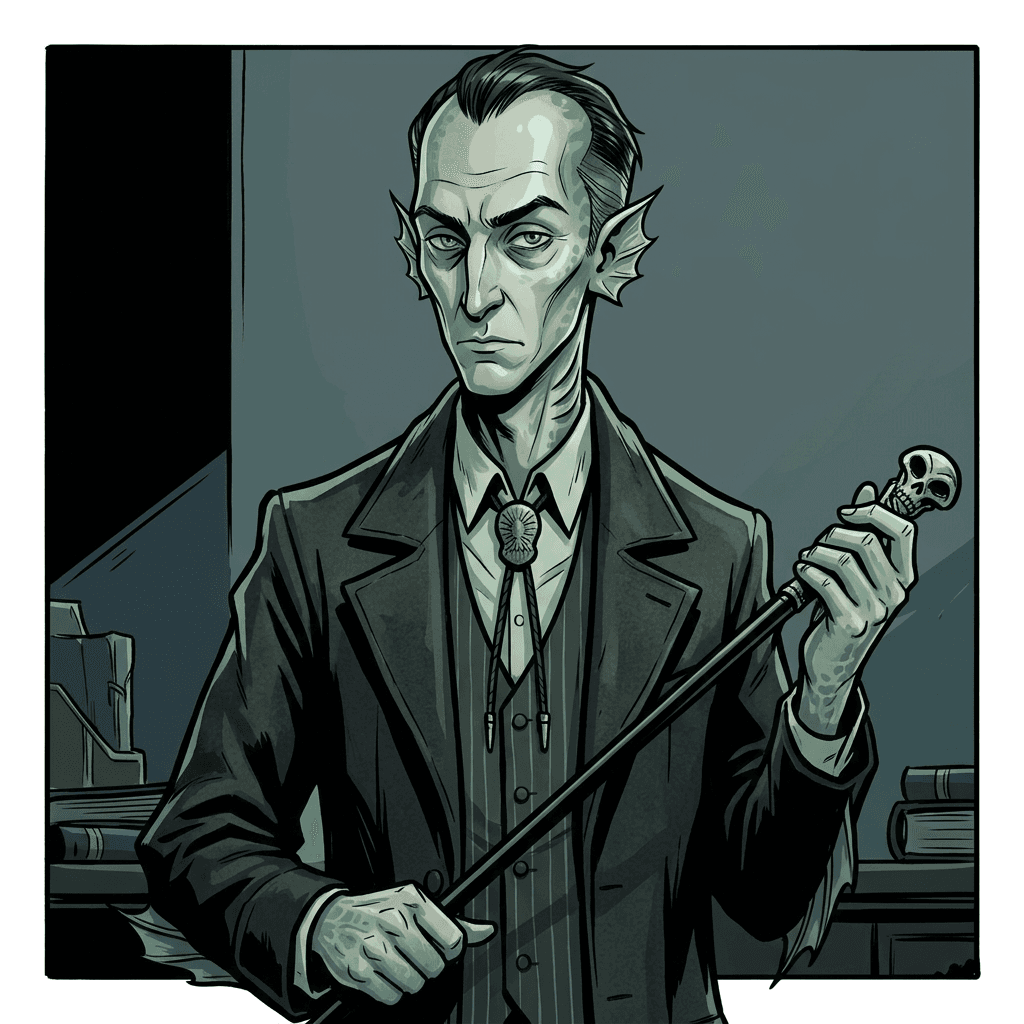
Registrar Vale Quill portrait

The Records Man

Registrar Vale Quill

Kills cleanly through paperwork

Known For

Eel-slick precision and polished bureaucratic menace

Weapon

Records, procedure, and false certainty

First Appearance

Issue #1: The Alibi Auction

He believes documentation is the most civilized form of violence.

Vale Quill is the sort of antagonist this world needs: not loud, not bulky, not built out of standard mob shorthand. He is dangerous because he is administrative. He understands that once the record is accepted, the body barely matters, and he treats that gap between truth and documentation as a business opportunity.

His design should always feel precise, eel-slick, and socially ambitious. He is a reminder that the comic's criminal pressure does not come only from guns and muscle; sometimes it arrives in tailored black, already notarized.

Dossier note: Civic death-record official · Issue #1

The roster grows issue by issue. Right now the page focuses on the recurring family core and the characters who define the first case, but the larger city is already crowded with worse people and stranger systems.